

Executive Summary: Two Generations Inside One Model Family
Between August 2026 and November 24, 2026, the MAGI-2 architecture made one of the fastest documented quality leaps in generative video history. Yet because both releases share the same family name, developers and filmmakers routinely confuse what MAGI-2-Preview (the Apache 2.0 checkpoint on Hugging Face) can do versus what the full 480B MAGI-2 flagship actually delivers.
Here is the core distinction in one glance:
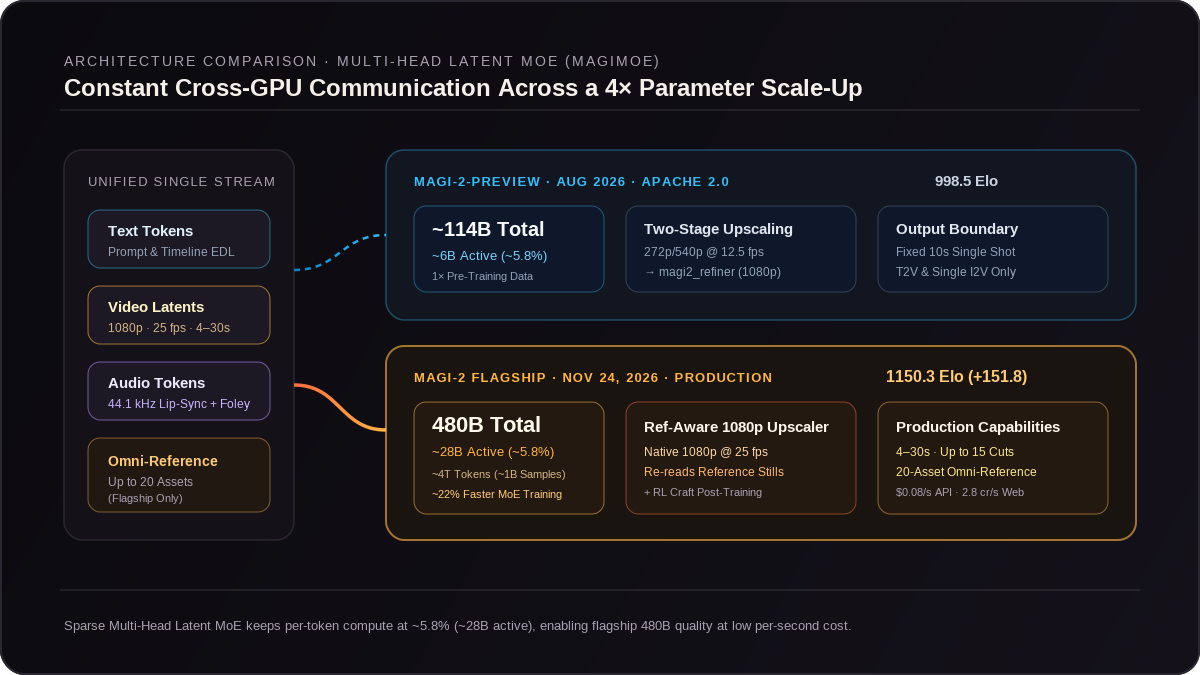
- MAGI-2-Preview (114B · Aug 2026) is an open-weight scaling proof-of-concept. With ~6B active parameters per token, it validated single-stream audio-video Mixture-of-Experts training—but remained locked to 10-second clips, a 12.5 fps low-res base +
magi2_refinertwo-stage pipeline, and basic T2V/I2V prompts. - MAGI-2 Flagship (480B · Nov 24, 2026) scales total parameters >4× (~28B active per token) and pre-training data ~3× to 4 trillion tokens. That scale-up unlocked a +151.8 Elo surge on Artificial Analysis Video Arena v2.1 (998.5 → 1150.3), 4–30 second native 1080p / 25 fps rendering, Omni-Reference conditioning (up to 20 multimodal inputs), second-accurate hard cuts, and prompt-driven video editing.
If your goal is shipping 1080p multi-shot video, character swaps, or synchronized dialogue, skip self-hosting Preview and test the 480B flagship directly via MAGI-2 Free on magie2.com. Only deploy MAGI-2-preview when Apache 2.0 open weights, custom fine-tuning, or air-gapped GPU research is a hard requirement.
Inside the Scaling Law: How Multi-Head Latent MoE Unlocked 480B
Most video diffusion backbones hit a communication wall well before 200 billion parameters. Understanding how the MAGI-2 team broke through that wall explains why the flagship is both dramatically smarter and unexpectedly inexpensive per generated second.
1. Constant-Communication Multi-Head Latent MoE (MagiMoE)
In conventional Mixture-of-Experts (MoE) layers, scaling total expert count explodes all-to-all token traffic across GPUs, stalling utilization on long audio-video sequences. Both checkpoints use Multi-Head Latent MoE, where each token is partitioned into multiple sub-heads with independent routers and latent expert pools.
The crucial engineering payoff: cross-GPU communication volume stays flat even as total parameters quadruple from ~114B to 480B. Compared to a single-head LatentMoE baseline, this delivers roughly a 22% training speedup—while keeping runtime activation ultra-sparse at ~5.8% (~28B active parameters out of 480B).
2. Single-Stream Audio-Video Attention at 4.5× Active Capacity
Both MAGI-2-Preview and MAGI-2 unify text, video, and 44.1 kHz stereo audio inside one continuous Transformer sequence rather than bolting a foley generator onto a silent video model. However, sharing ~6B active parameters across 3D scene physics, camera parallax, and audio synthesis forced Preview into tight compromises—especially on spoken lip-sync and dense acoustic perspective. Expanding active compute to ~28B lets the flagship attend simultaneously to facial micro-articulation, footsteps, cloth rustle, and acoustic distance across 30 full seconds.
3. Unfiltered 4-Trillion-Token Pre-Training (~1B Samples)
Standard industry recipes aggressively scrub "hard" footage (crowded streets, rapid cuts, small signage, overlapping sound) to keep loss curves smooth. For the 480B flagship, the training corpus expanded roughly 3× to ~4 trillion tokens (~1 billion samples) while intentionally retaining messy real-world video.
Because anatomy, crowds, and complex physics stabilized during pre-training, reinforcement learning (RL) post-training no longer had to patch broken hands or melting faces—it could focus directly on cinematic polish: skin pores, fabric weave, fur dynamics, lens falloff, and realistic specular lighting.
4. Emergent Pre-Training Capabilities vs. RL Craft Trade-Off
Scaling to 480B on 4T tokens produced surprising zero-shot emergent behaviors on the raw pre-trained weights (with prompt rewriting disabled):
- Visually solving and writing out a 9×9 Sudoku puzzle
- Autonomously designing multi-angle shot coverage from a minimal plot beat
- Translating spoken dialogue into another language inside the generated scene
Candidly, the developers also noted an important research trade-off: applying heavy aesthetic RL post-training to maximize commercial visual polish makes those raw emergent reasoning behaviors harder to invoke reliably in the production checkpoint.
Complete Technical Specification Matrix
| Dimension | MAGI-2-Preview (sand-ai/MAGI-2-preview) | MAGI-2 Flagship (Nov 2026) | Why It Matters in Practice |
|---|---|---|---|
| Release Window | August 2026 | November 24, 2026 | 3-month jump from open research milestone to production flagship |
| Total / Active Parameters | ~114B total / ~6B active | 480B total / ~28B active | >4× capacity, ~4.5× active compute per token at ~5.8% sparsity |
| Pre-Training Corpus | 1× baseline | ~4T tokens (~1B samples, ~3×) | Fewer anatomical errors, stronger crowd & typography coherence |
| Video Arena v2.1 (4-Task Avg) | 998.5 Elo | 1150.3 Elo (+151.8) | ~70.6% implied human preference win rate over Preview |
| Higgsfield Arena (Nov 24) | Not top-tier competitive | #2 Overall (1146 BT · 60.5% win) | Beats Seedance 2.0 (71%), Wan 3.0 (79%), Kling 4.0 (83%), MiniMax H3 (83%) |
| Duration Range | Fixed 10 seconds | Continuous 4 to 30 seconds | Complete narrative scenes and ad spots in one coherent pass |
| Base Resolution & Frame Rate | 272p (448×256) or 540p (896×512) @ 12.5 fps → magi2_refiner | Native 1080p @ 25 fps via reference-aware latent upscaler | 2× smoother motion; upscaler re-reads reference stills for crisp faces & logos |
| Aspect Ratios | Preview defaults | 6 native ratios (16:9, 21:9, 4:3, 1:1, 3:4, 9:16)* | Native widescreen cinema and vertical social delivery |
| Audio Engine | Unified 44.1 kHz stereo (stable-audio-open-1.0 component) | Unified dialogue lip-sync, foley, spatial ambience & score | Reliable multi-beat speech rhythm and spatial perspective |
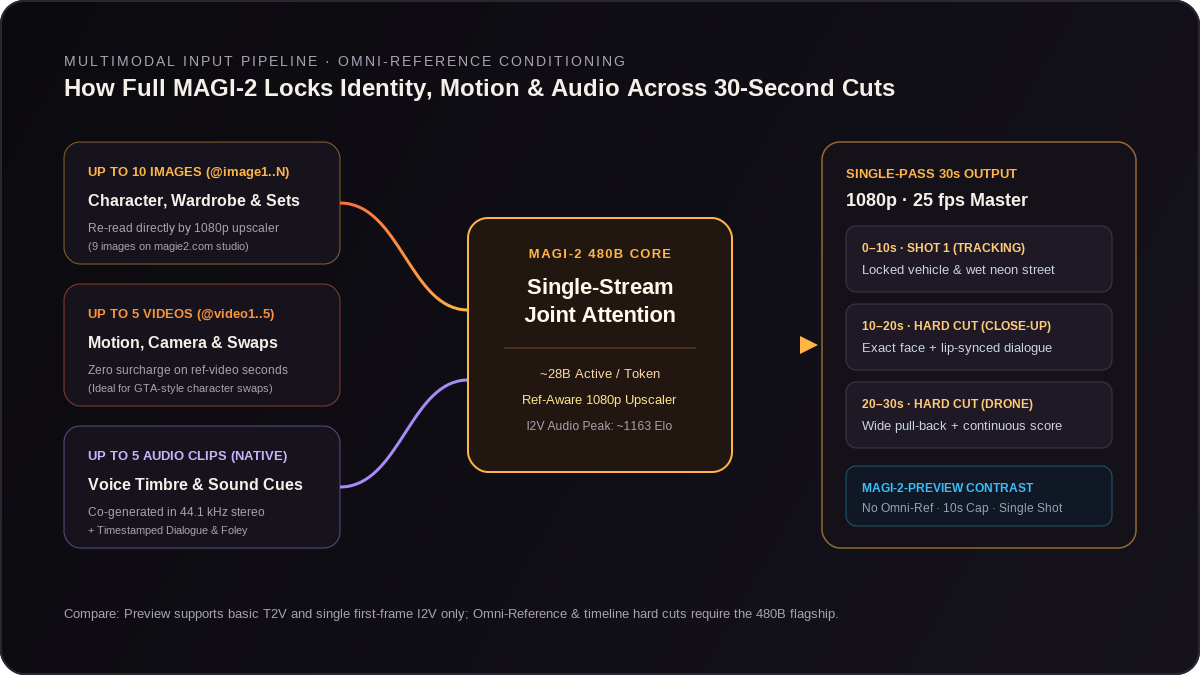
| Multimodal Conditioning | Text-to-Video & single Image-to-Video | Omni-Reference: up to 20 items (10 img + 5 vid + 5 audio)* | Lock character likeness, sets, motion choreography, and audio cues |
| Timeline & Editing | Single-shot generation only | Timestamped hard cuts (up to 15 in 30s) + video editing | Direct multi-shot edits directly from a timed script |
| Text Encoder / Stages | Qwen/Qwen3.5-27B + two-stage denoiser & refiner | End-to-end flagship inference + RL craft post-training | Eliminates two-stage detail drift on eyes, hands, and packaging |
| Weights & Licensing | Apache 2.0 (downloadable today on Hugging Face) | Hosted studio & API live; open weights announced | Preview for local research today; Flagship for cloud production |
| Footprint / API Economics | ~274–328+ GiB disk; 8× Hopper ref (or 96 GB NVFP4) | $0.08/s official API; 2.8 credits/s on magie2.com | Flagship avoids multi-GPU ops while costing ~84% less than Seedance 2.5 |
*Platform UI note: While the underlying MAGI-2 model supports 6 aspect ratios and up to 20 multimodal references, hosted studios tailor UI quotas. On magie2.com, MAGI-2 supports 4–30s 1080p generation, 16:9 / 9:16 / 1:1, and up to 9 reference images + 5 reference videos with zero extra surcharge on reference-video seconds.
Benchmark Analysis: Video Arena v2.1 & Competitive Standing
A +151.8 Elo jump across four independent evaluation tracks is not an incremental fine-tune—it is a generational tier change. Plugging +151.8 into the logistic Elo expectation formula (1 / (1 + 10^(-151.8 / 400))) yields an implied 70.6% head-to-head human preference win rate for MAGI-2 over MAGI-2-Preview.
In the independent Nov 24, 2026 Higgsfield Video Arena blind director ranking, MAGI-2 Flagship landed #2 overall (1146 Bradley-Terry, 60.5% overall win rate)—second only to Seedance 2.5 (1219) while outperforming Seedance 2.0 (71% H2H), Wan 3.0 (79% H2H), Kling 4.0 (83% H2H), and MiniMax H3 (83% H2H).
Why did Image-to-Video with Audio open so strongly near ~1163 Elo? Because MAGI-2's reference-aware 1080p latent upscaler directly re-attends to your uploaded image during fine-detail reconstruction—whereas MAGI-2-Preview's magi2_refiner only upscales the already-compressed 272p/540p base latent, causing faces, logos, and textures to blur or morph. For a side-by-side comparison against the #1 leaderboard model on cost and visual fidelity, see MAGI-2 vs Seedance 2.5.
The Omni-Reference & Timeline Gap: Where Preview Stops Cold
If you build character-driven shorts, stylized game-footage character swaps, or multi-shot brand spots, Omni-Reference conditioning is the real dividing line between Preview and Flagship.
What MAGI-2-Preview Can Do
- Prompt-only Text-to-Video (10s, 12.5 fps base → refiner)
- Single first-frame Image-to-Video (10s)
- No multi-asset character/location locking, no reference-video motion transfer, no targeted editing
What Full MAGI-2 Unlocks
- Multi-Asset Reference Packs (up to 20 natively; 9 images + 5 videos on magie2.com): Bind a character sheet, specific jacket, car or product prop, environment still, and camera choreography clip into one unified generation. This is the exact pipeline powering viral third-person game-footage character replacements—explore our GTA 6 AI Video Generator and full GTA 6 style character-swap walkthrough.
- Timestamped Hard Cuts (Up to 15 Cuts in 30 Seconds): Write shot blocks with exact second ranges instead of generating three mismatched 10-second clips and praying the lighting matches in Premiere.
- Zero Reference-Video Billing Penalty: On magie2.com, MAGI-2 bills strictly on output seconds (2.8 credits/s)—uploading a 10-second reference clip to drive camera or fight choreography costs zero extra credits for the input seconds.
Flagship-Only 30-Second Omni-Reference Action Prompt
Here is a 3-cut, 30-second sequence showcasing multi-shot pacing, reference locking, and synced dialogue + vehicle foley that MAGI-2-Preview cannot execute natively (try it in the AI Video Generator or browse more templates in MAGI-2 Prompts):
30 seconds, 16:9, anamorphic 35mm night cinematography, rain-slicked downtown overpass.
Lock the driver's face and crimson racing jacket from @image1 and the matte-silver coupe from @image2.
0–10s: Low tracking shot skimming wet asphalt beside the spinning front wheel as neon signage reflects across rain streaks; deep twin-turbo exhaust rumble and steady rain hiss.
10–20s: Hard cut inside the dimly lit cockpit, medium close-up on the driver gripping the wheel. He glances into the mirror and says calmly over the engine hum: "Two blocks left—keep the line clean." Natural lip-sync, dashboard amber reflections across his eyes.
20–30s: Hard cut to a sweeping overhead drone pull-back as the coupe drifts smoothly onto a coastal bridge glittering with city lights in the mist; tire screech fades into distant ocean wind and a deep synth pulse.
Self-Hosting MAGI-2-preview vs. Cloud Flagship Economics
Open weights under Apache 2.0 are genuinely valuable for AI labs—but many solo creators underestimate the infrastructure bill required just to load the 114B checkpoint into memory.
Real Hardware Footprint for sand-ai/MAGI-2-preview
- Storage footprint: ~274 to 328+ GiB across the complete Hugging Face package (~228 GB main transformer, ~56 GB
Qwen/Qwen3.5-27Btext encoder, plus VAE,magi2_refiner, and audio components). - Official reference clusters: Designed around 8× NVIDIA Hopper GPUs (H100/H200) or 4-GPU sequence-parallel (SP4) nodes using containerized pipelines or community vLLM-Omni serving stacks.
- Quantized single-GPU ceiling: Community NVFP4 builds (including experimental ComfyUI integrations) bring the model down to a single enterprise workstation card—but still demand roughly 96 GB VRAM (such as an NVIDIA RTX PRO 6000 Blackwell), far beyond 16–24 GB consumer GPUs.
Side-by-Side Cost Math (November 2026)
| Output Length (1080p + Audio) | Official MAGI-2 API ($0.08/s) | magie2.com Credits (2.8 cr/s) | Approx. Effective Cost* | Self-Hosted MAGI-2-preview (Cloud GPU) |
|---|---|---|---|---|
| 5 seconds | $0.40 | 14 credits | ~$0.58–$0.70 (yearly / BOGO) | Fixed 10s pipeline; billed per GPU-hour even when idle |
| 10 seconds | $0.80 | 28 credits | ~$1.16–$1.40 | Requires 4×–8× Hopper or 96 GB GPU ($3–$25+/hr) |
| 30 seconds | $2.40 | 84 credits | ~$3.49–$4.19 | Unsupported natively (10s cap) |
| 10s Ref Video → 10s Clip | Billed on output | 28 credits ($0 ref fee) | ~$1.16–$1.40 | Unsupported (no Omni-Reference mode) |
*On magie2.com/pricing, non-expiring credit packs start at $19.90 (200 credits), monthly plans start at $29.90 (with 2× first-month BOGO credits), and annual plans offer up to 50% savings. Free accounts receive welcome credits (no credit card required) to test a 4-second 1080p clip with audio.
Decision Matrix: Flagship vs. Open-Weight Preview
- You need client-ready 1080p / 25 fps video with realistic skin, lighting, and synced dialogue.
- Your storyboard calls for 15–30 second scenes or timed hard cuts in one cohesive render.
- You rely on Omni-Reference assets (character sheets, product stills, reference-video swaps).
- You want predictable per-second economics without provisioning 8× H100 nodes or 330 GB NVMe arrays.
- You are researching Multi-Head Latent MoE routing, distillation, or FP4/FP8 video quantization.
- You need Apache 2.0 weights today for custom fine-tuning, LoRA experiments, or vLLM-Omni benchmarks.
- Strict compliance mandates air-gapped on-premise inference with zero third-party API egress.
- Your team already owns or leases 4×–8× Hopper GPUs or 96 GB Blackwell hardware.
Honest Limitations to Account For in Production
Even with a +151.8 Elo jump, the 480B MAGI-2 flagship has documented boundaries worth designing around:
- Ultra-fast chaotic action: Whip pans, dense melee strikes, and flying debris can still introduce occasional limb distortion or temporal flicker—anchor fast beats around one clear focal subject per cut.
- Medium and wide 2D animation: While close-up anime frames look crisp, medium and wide hand-drawn shots can exhibit slight over-smoothing of secondary motion.
- Complex layered broadcast mixes: Dialogue and core foley sync reliably, yet dense multi-source mixes (e.g., roaring stadiums plus orchestral score and overlapping dialogue) still benefit from light audio sweetening in post.
- RL polish vs. emergent reasoning: Production RL post-training optimizes cinematic fidelity over raw pre-training reasoning quirks like visual puzzle solving.
- Pending 480B open weights: Organizations needing fully local weights at flagship quality must wait for the promised follow-up open-weight release—and plan for multi-node Hopper/Blackwell compute once it arrives.
Frequently Asked Questions
How do MAGI-2 and MAGI-2-Preview differ in parameter count and compute?
MAGI-2-Preview (August 2026) is an open-weight research checkpoint with ~114B total parameters (~6B active). Full MAGI-2 (November 24, 2026) scales more than 4× to 480B total parameters (~28B active) on ~4 trillion tokens (~3× data) using Multi-Head Latent MoE.
What does the +151.8 Elo gap on Artificial Analysis Video Arena v2.1 represent?
Across the 4-task Video Arena v2.1 average (T2V audio, T2V silent, I2V audio, I2V silent), MAGI-2 moved from 998.5 Elo on Preview to 1150.3 Elo on the 480B flagship—an implied ~70.6% pairwise human preference win rate for the flagship.
Why is Omni-Reference conditioning exclusive to full MAGI-2?
Preview only supports single-shot text-to-video and first-frame image-to-video on a 10-second, 12.5 fps base pipeline. Full MAGI-2 introduces native Omni-Reference conditioning (up to 20 media assets natively) paired with a reference-aware 1080p latent upscaler that directly re-reads reference stills when reconstructing fine details.
Does MAGI-2 lose anything when RL post-training is applied after pre-training?
There is an explicit trade-off: raw 480B pre-training exhibited emergent reasoning behaviors (such as solving 9×9 Sudoku visually, autonomous shot coverage, and spoken translation), whereas RL craft post-training prioritizes lighting, skin, fabric, and fur fidelity for commercial filmmaking, making those raw emergent quirks harder to trigger.
Can MAGI-2-Preview run on a single RTX 4090 or 5090 locally?
No. The Hugging Face package requires roughly 274–328+ GiB of disk storage (~228 GB transformer + ~56 GB Qwen3.5-27B text encoder). Official scripts target 8× Hopper GPUs or 4-GPU sequence-parallel nodes, and heavily quantized community NVFP4 builds still require roughly 96 GB VRAM (e.g., RTX PRO 6000 Blackwell).
When will the full 480B MAGI-2 weights become open source?
sand-ai/MAGI-2-preview is available under Apache 2.0 today. For the 480B flagship, open weights and technical documentation have been announced to follow the initial hosted and API launch.
How much does it cost to generate 1080p MAGI-2 video compared to renting GPUs for Preview?
Official MAGI-2 API inference is $0.08/second ($0.80 per 10s), and magie2.com bills 2.8 credits/second (28 credits per 10s, zero reference-video surcharge). Renting 4×–8× Hopper GPUs or a 96 GB workstation to host the 10-second Preview model costs $3–$25+/hour regardless of idle time.
Can I test the 480B MAGI-2 flagship in my browser before buying credits?
Yes. Sign up free on MAGI-2 Free (no credit card required) to claim welcome credits and generate a 4-second 1080p MAGI-2 video with native synchronized audio in your browser.
Put the 480B Flagship to Work
- Try MAGI-2 Free Online — Render a 4-second 1080p native-audio test clip with free welcome credits (no card required).
- Open the MAGI-2 Video Generator — Build 4–30s 1080p scenes with up to 9 reference images + 5 reference videos.
- MAGI-2 vs Seedance 2.5 Benchmark — Compare Higgsfield Arena scores and 1080p cost savings side by side.
- MAGI-2 Prompt Templates & Live Examples — Inspect tested 30-second shot lists, dialogue cues, and real renders.
- GTA 6 AI Video Generator — Put Omni-Reference character swaps to the test in stylized action footage.